
AI Model Review

Recent/upcoming developments… Warnings about AI safety and a commitment to slow down development of frontier models from Anthropic CEO Amodei, OpenAI’s Altman, Google DeepMind’s Hassabis, and xAI’s Musk generated widespread reaction in DC this week, with Congressional leaders acknowledging the need for legislative action to establish safeguards. There is already an active effort at the committee level to formulate different approaches. President Trump, who is closely aligned on the issue with NVIDIA CEO Huang, Meta’s Zuckerberg, and advisor David Sacks, pushed back on the need for AI regulation, despite reported support for it from Treasury Secretary Bessent and White House Chief of Staff Wiles.
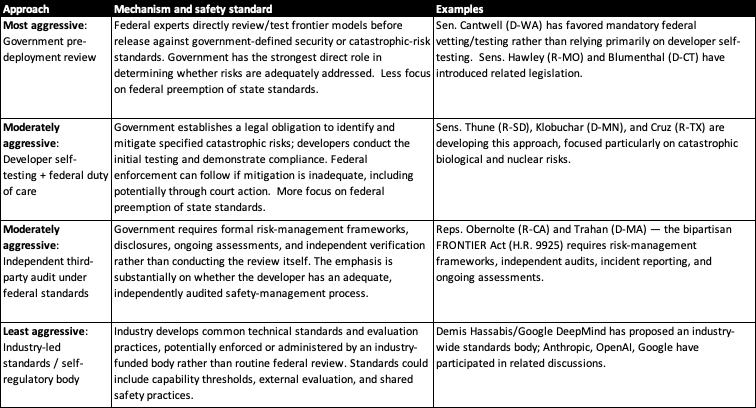
* Congressional leaders increasingly agree that AI risks warrant attention, but Republicans remain significantly more cautious about government intervention than are Democrats. Speaker Johnson (R-LA) has rejected a development moratorium and said companies should largely regulate themselves, although he has also endorsed independent auditing and transparency. House Minority Leader Jeffries (D-NY) has called for Congress to act faster and said lawmakers should consider measures to slow advanced AI development. Senate Majority Leader Thune (R-SD) continues to support a targeted, “light-touch” framework focused on catastrophic risks, while Senate Minority Leader Schumer (D-NY) has called for federal guardrails.
* The following table provides an overview of the approaches to AI model review emerging in Congress. They are listed by level of aggressiveness of their enforcement mechanism and the standards being tested. Democrats appear inclined to support more aggressive approaches.
* This debate comes on top of a Trump administration model-review framework that has already creating a federal role in frontier-model development. President Trump’s June Executive Order (EO) created a voluntary process through which developers provide federal officials access to covered frontier models for up to 30 days before broader release. While this approach is ostensibly voluntary, it is (politically) a de facto mandatory review regime.
Our outlook… The probability of enactment of AI model review legislation this year remains in our pre-existing ~15% range given the very limited time that remains on the legislative calendar, the immaturity of policy development in this area, partisan divides in Congress as to how aggressive regulation should be, and Trump’s resistance. However, the probability will move to ~40% next year given Democrats’ stated desire to be more active on this issue and the likelihood that they will have majorities in both the House and Senate. A damaging event caused by AI with visible implications for individuals and/or companies, particularly those outside of the tech industry, will be necessary to bring more Republicans and Trump on board with a stronger regulatory approach.
* Policy makers appear reluctant to subject open-source models to regulation (e.g., they are exempt from the Trump EO unless they reach the same capability level as proprietary models). The tech industry has broadly pushed back on regulation of open-source models because they want a source of competition with the OpenAI and Anthropic duopoly. We anticipate that industries more broadly will begin to express this view. It is our expectation that because of this concern, President Trump (who again, appears influenced by open-source advocates like Huang, Zuckerberg, and Sacks) will remain resistant to restricting use of Chinese open-source models. Once a strong U.S.-based open source competitor emerges, there is likely to be more receptivity to restricting use of Chinese models.
Watch for these developments… The White House is reportedly planning a meeting with the leaders of the AI model firms next week. We are watching for whether Trump is more willing to embrace some form of model regulation coming out of this meeting. We are also watching for whether the Senate Commerce Committee, led by Sen. Cruz, votes on model review legislation in the coming weeks as he has said he is considering. If the committee produces legislation on a bipartisan basis, it will provide a foundation on which Congress will build next year. More generally, we are watching for how the views of those Democrats in Congress who will lead AI policy next year (i.e., Senate Commerce Committee Ranking Member Cantwell and House Energy and Commerce Committee Pallone (D-NJ)) are beginning to evolve.