
Data Centers


Recent/upcoming developments… House Republican leaders have decided to vote next week on the Ratepayer Protection Act (RPA), a bill that requires state utility regulators to consider adopting a federal standard directing data centers to pay for new generation and transmission upgrades required to serve them. The bill passed in the Energy and Commerce (E&C) Committee in July on a unanimous basis. President Trump has expressed strong support for data centers and has responded to voter concern about their effect on power usage by encouraging governors and industry to sign a pledge that data centers will pay for their own power and infrastructure use, which is essentially what the RPA achieves. A large number of governors and industry players have signed the pledge.
* The Data Center Coalition, which is industry’s primary trade association, backed an earlier version of the RPA but has backed away from the latest version because its focus was narrowed only to data centers and does not effect large load users in other industries. Other manufacturing industry groups such as the Iron and Steel Institute and the Industrial Energy Consumers of America support the current version of the RPA.
Our outlook… The RPA will pass in the House next week but is unlikely to progress further in the legislative process given Senate disinterest in it and the limited time that remains in this year’s legislative calendar, though there is some potential that Senate Republicans could change their approach and pass the bill. This dynamic is consistent with our pre-existing view that the bill has a 30% probability of enactment this year and will rise to 60% next year. Democrats have said they plan to make energy affordability a major focus of their agenda next year if they gain majorities in the House and Senate (which is likely). Data centers will be a significant focus of that agenda, which will likely include passage of the RPA. And, as our analysis below demonstrates, most states with a large concentration of data centers are moving towards adopting new “pay your own way” regulatory standards, and with a pause/moratorium only temporary in nature in NY and TX.
* Sen. Husted (R-OH) has introduced the RPA in the Senate, but the bill has not gained momentum in that chamber, with Senate Energy and Natural Resources (ENR) Chair Lee (R-UT) saying in recent months that it is not a priority.
* The following is an overview of Democratic proposals that will likely get focus next year when they have majorities in the House and Senate. We have assigned a preliminary probability of enactment for these proposals next year based on the likelihood they will get focus, their potential to gain the bipartisan support necessary for enactment, and their general feasibility.
60+% probability
– Ratepayer Protection Act (RPA): Requires states to consider standards ensuring data centers bear the costs of new generation and transmission infrastructure needed to serve their electricity demand.
– Data Center Transparency Act: Requires EPA and EIA to regularly publish data on data centers’ environmental impacts, energy consumption, and effects on household electricity costs.
40-60% probability
– GRID Savings Act: Gives FERC authority over interconnection of large loads of at least 150 MW and directs it to establish rules governing studies, cost allocation, financial requirements, transparency, reliability, and transmission-service rights.
– Protecting Families from AI Data Center Energy Costs Act: Directs FERC to convene utilities, regulators, consumer advocates, large-load customers, and other stakeholders to develop strategies for shielding residential and small-business customers from data-center-driven electricity costs.
– AI Data Center Site Selection Transparency Act: Requires developers of AI-focused data centers to disclose location and resource-use information to local officials before development and limits certain nondisclosure agreements.
20-40% probability
– Power for the People Act: Directs FERC and states to create special interconnection, cost-allocation, and utility-rate rules for large data centers, with incentives tied to clean energy, storage, load flexibility, and labor standards.
– PRICE Act: Requires data centers to generate enough electricity to cover their consumption, with that generation reaching 75% renewable energy by 2035 and 100% by 2040, backed by civil penalties for noncompliance.
<20% probability
– AI Data Center Moratorium Act: Imposes a federal moratorium on new or expanded AI data centers until Congress establishes comprehensive national safeguards governing AI development and impacts.
– No Harm Data Centers Act: Expands FERC authority over electricity rates for data centers of at least 50 MW, requires them to bear specified grid costs, limits certain NDAs, and commissions a federal study of data centers’ environmental and public-health effects.
– Protecting Communities from Data Center Impacts Act: Requires federal public-interest certification for data centers and conditions development on measures addressing grid costs, demand flexibility, clean energy and storage, labor standards, and local environmental impacts.
* The following is an overview of how states with a large concentration of data centers are moving forward. A detailed explanation of these policies can be found in the spreadsheet at this link.
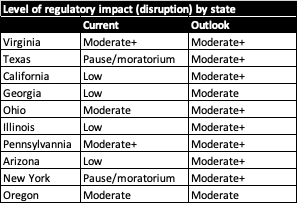
Watch for these developments… We are watching for the level of Democratic support that the RPA gets in next week’s House vote. Our expectation is that more than half of House Democrats will support it, which will reinforce our view that it is likely to be enacted next year under Democratic majorities. If House Democrats object to it, the probability of enactment next year will decline. We are also watching for the position that key Democrats who will drive energy policy next year (e.g., House E&C Ranking Member Pallone (D-NJ), Senate ENR Ranking Member Heinrich (D-NM), Senate Environment and Public Works (EPW) Committee Ranking Member Whitehouse (D-RI)) take on the RPA. We are assuming they will embrace it but if they do not, its probability of enactment will decline. We are also watching for whether they want to pursue some of the more aggressive proposals that have been made on data centers as that could change the probabilities we assigned in the list above.